

Newsletter:
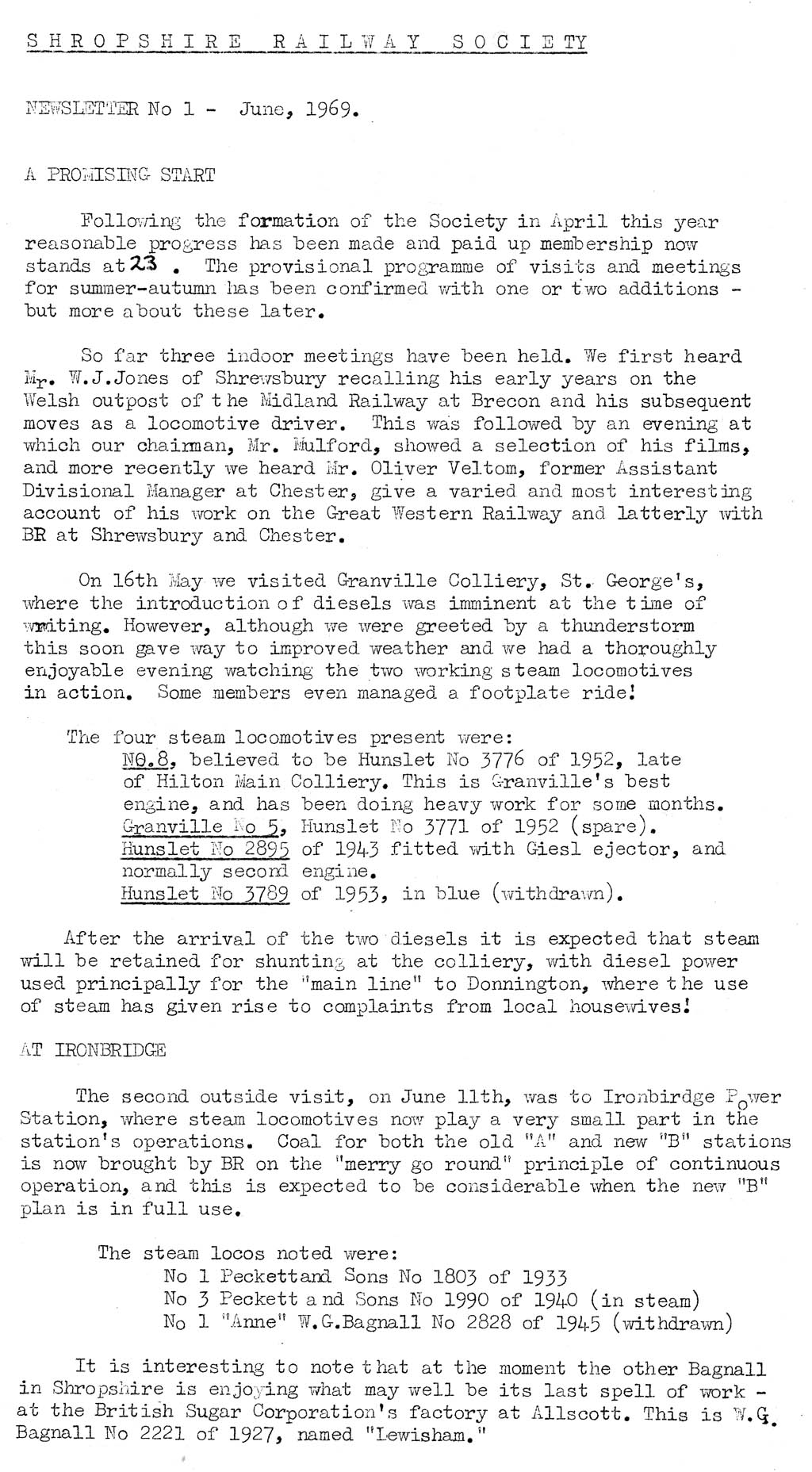
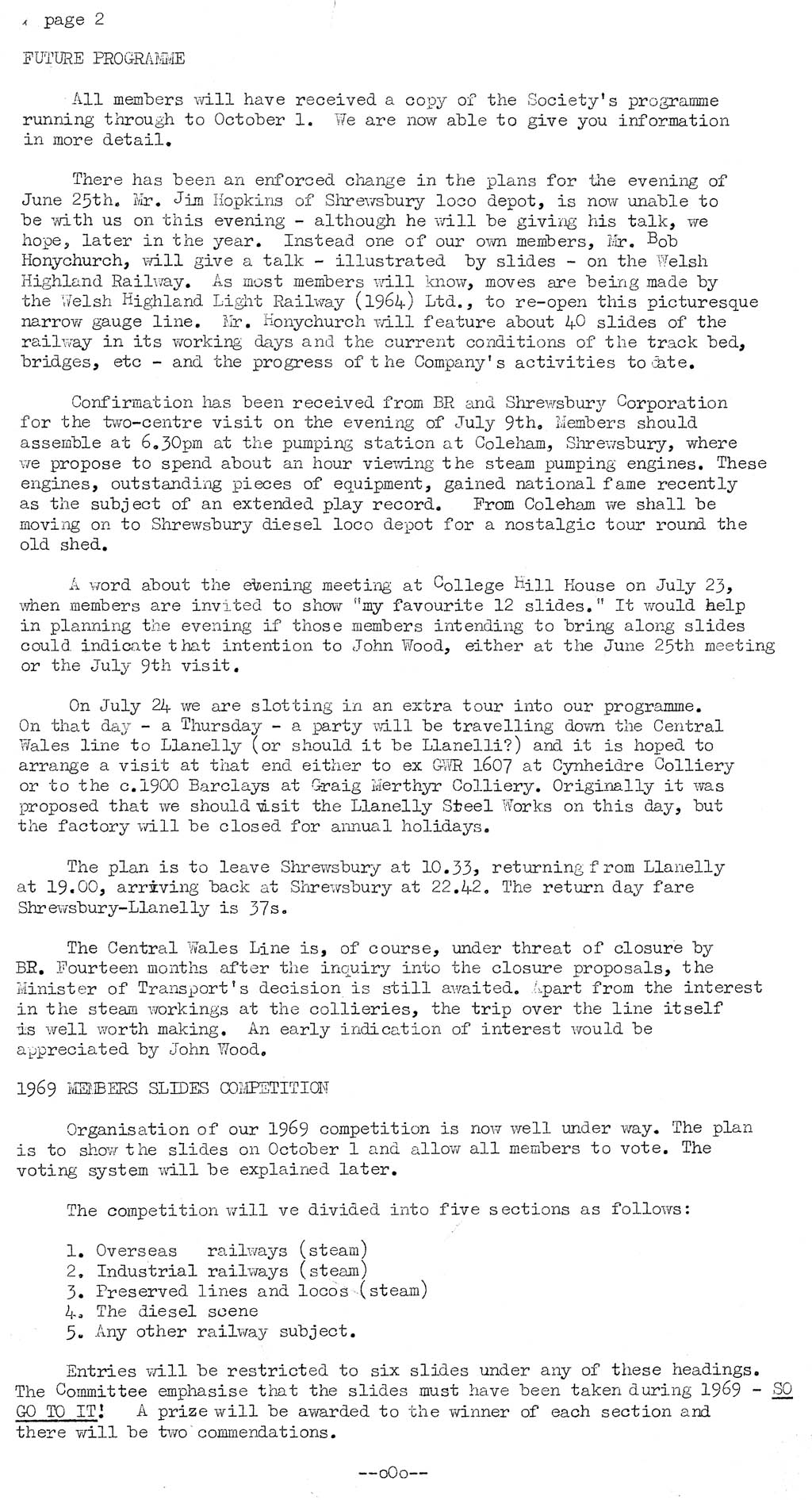
A monthly newsletter keeps members in
touch, including society news and
events, articles by members and items
from the local press.
Read an article from a recent newsletter
"The Battlefield Line"
Read a meeting report from a recent
newsletter
The Battlefield Line Saturday 7 August
Our driver was Dave Parry who picked up Ray Latty and myself in
time to park, obtain tickets and be on the platform for the 0831 to
Birmingham. Another of our members, Stewart Henderson, was on
the station, awaiting his overdue diesel charter. Our train arrived
ahead of time but it was fairly crowded and I was cramped in a
corner seat with only a small window and very close to the seat in
front. However, when the stationary train gave a slight shiver we
realised that something had been added to the front, and after
checking with the conductor, we made our way forward to where
three coaches had been coupled to the original two unit 158 coaches
and found seats with a table in the more comfortable Midland
coaches.
Among the other passengers were what we surmised were football
supporters, among which was one chap with his face painted
crimson all over and about seven hairy cross-dressers who looked as
if they were going to a Garden Party. It takes all sorts to make a
world! At Wellington we took on board two more of our members,
Paul Davies and his "Dad". We changed trains at New Street and
caught the next Leicester train, having a quite smooth, relatively
quiet ride as far as Hinckley. To get to the Battlefield Line we had to
take a large taxi to take the five of us to Shenton, which was the
nearest point on the Battlefield line.
Apparently we had missed, by a few minutes, the train to the line's
main station at Shackerstone, at the other end of the line, and this
gave us time for a cup of coffee, with a treacle tart for me, and a
good look around this little country station. The main building on the
platform housed a glass-blower's studio, a display of his works for
sale, some abstract paintings and the small kitchen/cafe. I
understand that the building was dismantled brick by brick in the
Leicester area and reassembled at Shenton and looked absolutely
perfect. On the opposite platform was the original small single storey
building which I assume had to be used to perform all the original
station functions, although beyond that we could see the roof and
chimneys of what could have been the Stationmaster's rather more
imposing house.
Eventually the next train arrived- ex GWR Prairie lank 5422, bunker first.
After watching and photographing the loco running round we climbed
aboard, found seats and those of us who hadn't bought tickets at Shenton
got the train staff, with much banter, to bring their ticket-holder to sell us
Edmundson type tickets. On arrival at Shackerstone one of the staff took
us over the footbridge to the main station building and introduced us to a
gentleman in overalls, sitting drinking a cup of tea, who when he had
finished his drink, took us about 50yards along the complex to an engine
shed to show us his loco- 4-6-0 No 1306, "Mayflower", which he has
owned for over 30 years. This was the highlight of our day. To be beside
such a well cared-for machine was so impressive. The Apple Green with
white-edged black bands livery looked as if it had been spray-painted, but
he assured us that it was done by his son and himself using brushes!
Everything was gleaming, brass, motion and all the paintwork.
Back in the main building we looked in the two rooms of their museum I
have never seen so much railway memorabilia crammed into any similar
sized rooms. All collected by John Jacques MBE. If the MBE wasn't for
assembling all the artefacts then he deserved another for it. On the
opposite platform was a newer building housing the Gift Shop, I must
admit to having seen better choices of merchandise in other preserved
railway shops. Eventually we boarded our 14.30 train back to Shenton,
same Prairie loco and en-route Paul phoned for our return taxi
During a short wait for our Birmingham train we had a very long ballast
train go by; it slowed our following train slightly, but not enough to grumble
about. At Birmingham we were straight off our ex-Hinckley transport on to
the return Shrewsbury train with lots of passengers scrambling for seats
Ray, Dave and I were lucky to find seats together at a table, and guess
what! - the morning ladies were next to us and all in party-mood, sending
squeaking balloons along the carriage, drinking cans of lager and full of
bonhomie I heard one say that he "didn't like travelling on trains with
drunk people." It seems that they had been to the Test match and Mike
Gatting had presented them with the first prize in the Fancy Dress
competition. I told them to remember what Mother had told them and not
get pregnant and took a few photos of them and their trophy, for which
they seemed quite pleased Our Wellington members left the train as
planned and we got off at Shrewsbury, talking over an enjoyable day with
a pint in the Albion.
Bruce Spurr
Meeting Report: "Railways at the dawn of Nationalisation” Robin Mathams
The third meeting of the 2010-11 season saw a return visit to the Gateway of Rugeley-based Robin
Mathams who gave an illustrated talk entitled "Railways at the Dawn of Nationalisation - 1946 to
1949" before another substantial audience.
The talk was based on one particular railway enthusiast in the 1940's, the late Percy Moseley who
took photos from 1913 to the 1970's. Robin first of all gave us an insight how he got hold of “The
Moseley Collection”. Each photo had to be 'touched up' to try to gel the best picture Robin could
get. A lot of hard work is required to achieve the resulting image and Robin has seemed to get the
best result every time.
1946 saw images of bomb damage in Coventry show on the big screen. Incidentally when the
railways were nationalised, 20,000 locomotives had to be renumbered. A favourite spot for Mr
Moseley to photograph trains was Cathiron near Rugby. There seemed to be an endless number of
images on the big screen from that spot. Each picture displayed also had on top of it the location
and the date on which it was taken, with caption at the bottom.
All pictures shown were black and white steam images with the exception of two, these being
diesel electrics 10000 and 10001, shown in the 1949 section of the show. Some interesting
holidays snaps were shown too, for instance: Folkestone, Lowestoft, the Isle of Wight. Several now
preserved locos were noted: Princess Margaret Rose, Nunney Castle and Duchess of Sutherland;
photographs of the miniature Romney, Hythe and Dymchurch were shown as well.
Nationalisation of the railway took place on the 1st of January 1948. A few pictures of Birmingham
New Street in steam days were seen - how different from today - also several shots of railway
depots were shown - Rugby, Nuneaton, Coventry and Hitchin. It was not all railways, there were
even some images of boats on the River Thames screened for our enjoyment. The final shot of the
evening was one in Coventry, a typical steam scene. I thoroughly enjoyed the show, looking at all
those old scenes from the past.
Colin Hatch